Mobility, Safety and Flexibility: How Final Rentals Supports Travelers During Middle East Airspace Disruptions
March 3rd 2026
By Final Rentals | Dubai & Doha Operations Team
The skies above the Middle East have never felt more crowded, yet paradoxically, more closed. As geopolitical tensions escalate under the current operational context of "Operation Epic Fury," the aviation infrastructure that usually connects the world through the Gulf Cooperation Council (GCC) is facing unprecedented strain.
Major hubs like Dubai International (DXB), Abu Dhabi (AUH), and Hamad International (Doha) are experiencing intermittent closures and severe rerouting.
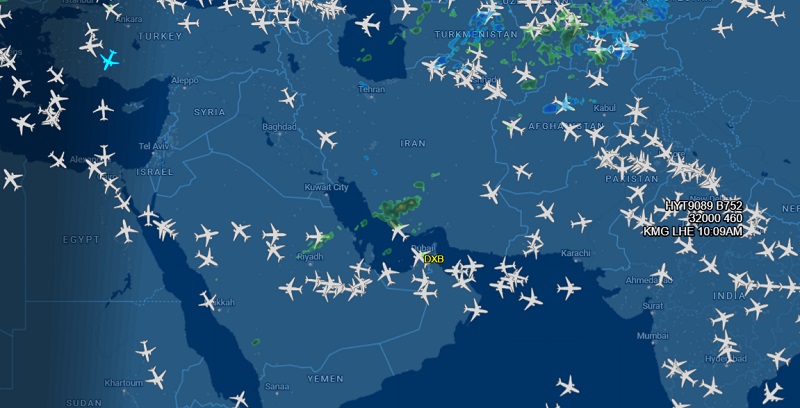
Image Courtesy: Flight Aware, March 03, 2026
For the over one million travelers currently in transit, stranded, or attempting to navigate this region, the message from airlines is often a simple, frustrating "wait." But waiting in a terminal or a hotel lobby without agency can be psychologically taxing and logistically risky.
At Final Rentals, we operate on the ground in Dubai and Qatar. We see reality not just through flight data, but also through traffic on Sheikh Zayed Road and queues at border crossings.
We believe that when the sky is uncertain, the road offers a vital alternative. This article is a strategic guide on mobility, safety, and logistical flexibility.
We are addressing the five critical pillars of travel during this crisis: cross-border ground mobility, maintaining agency while stranded, insurance transparency in conflict zones, flexible booking policies, and evacuation logistics for expats.
Cross-Border Mobility: When the Runway is Closed, The Road is Open
The most immediate impact of the current conflict is the disruption of air corridors. Data from the last 72 hours indicates that nearly 40% of regional flights connecting the UAE, Saudi Arabia, and Oman have been delayed or canceled due to airspace security alerts. For travelers needing to reach a safe zone or an open airport to fly out of the region, relying solely on aviation is becoming a high-risk strategy.
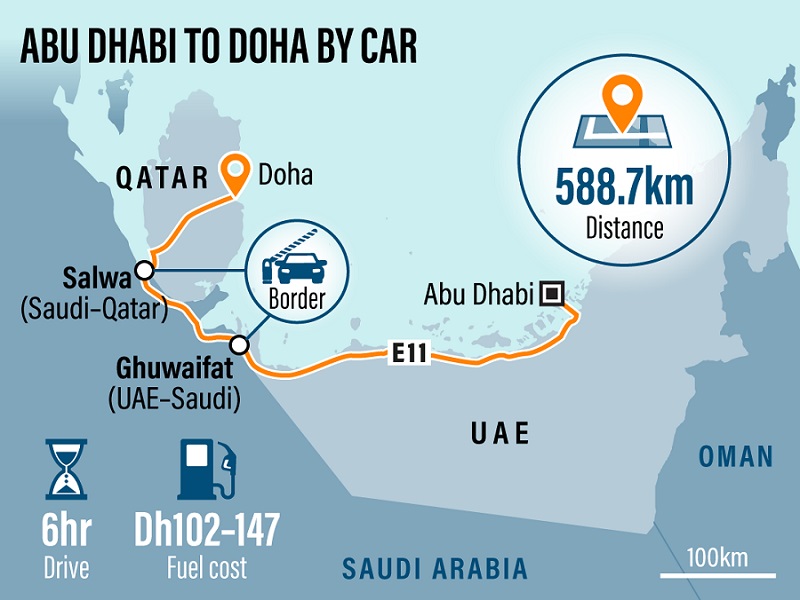
This is where long-term car rentals shift from a luxury to a logistical necessity. The GCC road network is among the most developed in the world. The drive from Dubai to Muscat, Oman, is approximately 4.5 hours via the Hili Border. The drive from Dubai to Dammam, Saudi Arabia, is roughly 6 hours. While airspace closes, land borders in the GCC have largely remained open for civilian transit, provided travelers have the correct visas and documentation.
For a traveler stuck in Dubai with a flight canceled for the next week, a rental vehicle offers the option to relocate to an airport that is currently operational. If Doha is facing restrictions, driving to a hub in Oman or Southern Saudi Arabia might be the only way to secure an onward flight to Europe or Asia.
However, this requires planning. At Final Rentals, we are advising clients to opt for long-term car rentals in the UAE (30+ days), which provide the stability needed for cross-border planning. A short-term daily rental often comes with mileage restrictions and insurance limitations that do not cover cross-border travel.
Our long-term fleet is equipped with GPS tracking, emergency roadside assistance that covers GCC borders, and the necessary vehicle registration documents (Mulkiya) required at customs.
We are not suggesting driving into conflict zones; we are suggesting using the robust GCC highway network to reach stability. If your departure airport is closed, mobility allows you to find one that is open.
The "Safe Harbor" Rental: Restoring Agency to the Stranded
The human cost of this conflict is measured in more than just canceled tickets. Currently, reports indicate that over 30,000 German tourists and 58,000 Indonesian pilgrims are stranded across the region, confined to hotels, cruise terminals, and airport lounges.
There is a psychological component to being stranded that is often overlooked: the loss of agency. When you are waiting for an airline to reschedule you, you are passive. You are dependent on their timeline, their logistics, and their decisions. For families with children, elderly pilgrims, or tourists unfamiliar with the region, this confinement can induce panic.
We are positioning the "Safe Harbor" rental as a tool for mental and physical well-being. Having access to a private vehicle means you are not confined to a hotel lobby. It means you can drive to a supermarket to secure extra supplies without relying on crowded delivery services.
It means if your hotel is in a high-density area that feels unsafe, you have the means to relocate to a quieter district or a different emirate immediately, without waiting for a transfer bus.
For the Indonesian pilgrims currently in the region, many of whom are part of larger groups, mobility allows group leaders to manage logistics more effectively. Instead of waiting for a charter bus that may never arrive, a fleet of rental vehicles allows for decentralized movement to consulates or safe assembly points. For the German tourists, many of whom are accustomed to independent travel, a rental car restores a sense of normalcy. It transforms a "waiting room" situation into a "road trip" situation.
You are still waiting for your flight, but you are waiting on your own terms, in a safe environment of your choosing. Final Rentals is prioritizing inventory for these stranded demographics, ensuring that SUVs and larger vans are available to accommodate families and groups who need to stick together.
Rental Protection vs. "Acts of War": What Travelers Need to Know?
Perhaps the most anxious question we are receiving at our counters in Dubai and Doha is about liability. "If I rent a car and it gets damaged due to the conflict, am I responsible?" This is a valid fear. Standard travel insurance policies and standard rental agreements often have a clause excluding "Acts of War," "Civil Commotion," or "Force Majeure." In normal times, this is fine print. In times of "Operation Epic Fury," this is the main text.
Transparency is the only policy that builds trust. We want to clarify Final Rentals' stance explicitly.
Most standard insurance policies exclude damage resulting from direct military action, terrorism, or nuclear hazards. However, the situation on the ground in the UAE and Qatar remains secure, despite the regional tension. The risk to a rental vehicle in Dubai is not typically from missile fire, but from secondary effects: panic driving, abandoned vehicles blocking roads, or theft during civil unrest.
Final Rentals has activated a Crisis Coverage Protocol for the duration of the current security alerts.
Collision Damage Waiver (CDW): Our standard CDW remains valid. If you are involved in an accident due to erratic traffic conditions caused by the crisis (e.g., sudden braking, evacuation congestion), you are covered under standard terms.
Theft and Vandalism: We are waiving the excess liability for theft or vandalism claims filed in regions under Level 2 Security Alerts, provided the vehicle was locked, and keys were not left inside.
War Exclusion: We must be honest: no private rental company can insure against direct acts of war (e.g., a missile strike on a parking lot). However, the likelihood of this occurring in the specific safe zones where we operate (Dubai Marina, Doha West Bay, etc.) is statistically negligible compared to the risk of being stranded without transport.
We advise all customers to purchase our Premium Protection Package during this period. This package lowers the deductible to zero for non-war-related incidents and includes 24/7 priority support. We are not hiding behind fine print. If a claim arises, our team assesses it on a case-by-case basis with a bias toward supporting the customer. We understand that in a crisis, financial liability is the last burden you need to carry.
Flexible Booking Policies in Times of Crisis
Governments worldwide, including the UK Foreign Office and the US State Department, are currently advising travelers not to go to the airport unless their flight is confirmed. This creates a paradox for rental customers: you need a car to get to the airport, but you don't want to book a car until you know you have a flight.
To resolve this, Final Rentals is announcing a Zero-Penalty Crisis Policy effective immediately for all bookings in the Middle East region.
Cancellation: Any booking made for pickup in Qatar, UAE, or Saudi Arabia can be canceled up to 2 hours before the pickup time with a full refund. No questions asked.
One-Way Flexibility: Normally, dropping a car off in a different city incurs a high fee. For the next 30 days, we are waiving one-way fees within the GCC to encourage movement toward open borders and safe zones.
This policy is designed to remove the financial risk of planning. Book the car now to secure your mobility. If your flight is canceled, cancel the car. If your flight is delayed, extend the car. We are absorbing the administrative risk so you can focus on your safety.
Logistics for Expats: Vehicle Access during Voluntary Evacuations
The scale of the expatriate community in the Gulf is massive. There are approximately 300,000 British citizens alone currently residing in or visiting the Gulf region, alongside hundreds of thousands of other Western and Asian expats. Several nations, including the U.K., are preparing evacuation systems, which may involve assembly points at ports or specific airports for charter flights.
Public transport during an evacuation is unreliable. Buses may be commandeered, and metros may reduce service. Taxis may become scarce or surge in price. For an expat family needing to reach an evacuation assembly point—often located in industrial ports or specific military zones—a private vehicle is the most reliable "last-mile" solution.
We have created a specific Evacuation Support Guide for our expat customers.
Vehicle Selection: We recommend SUVs with higher ground clearance. Evacuation routes may involve driving over curbs or through undeveloped areas near assembly points.
Fuel Policy: During our current rentals, we are advising customers to keep the tank at least 75% full at all times. Fuel queues can form quickly during alerts.
Documentation: We provide a digital and physical folder in every vehicle containing the car registration, insurance card, and a letter of authorization from Final Rentals in Arabic and English. This is crucial if you are stopped at military checkpoints while heading to an evacuation point.
Communication: All our vehicles are linked to our dispatch center. If you are heading to an evacuation assembly point, notify us. We can track your route and alert authorities if you encounter a blockade or breakdown.
For the 300,000 British citizens, many of whom may not own cars in the UAE, a rental is the bridge between their home and safety. We are prioritizing reservations for citizens who can provide proof of evacuation registration with their embassy. This is not about tourism; this is about repatriation logistics.
We view our fleet as part of the critical infrastructure supporting the expat community during this drawdown.
The Bigger Picture: Over One Million Disrupted Travelers
Current estimates suggest that over one million travelers are either stranded, rerouted, or facing flight uncertainty across the Middle East corridor.
Air travel is centralized and vulnerable to airspace restrictions.
Road mobility is decentralized and adaptive.
As a global car rental provider operating across Dubai and Qatar, Final Rentals focuses on three pillars during this conflict cycle:
Mobility
Cross-border and long-term rentals that replace short-haul regional flights.
Safety
Clear insurance transparency, security-zone guidance, and vehicle reliability standards.
Logistical Flexibility
Zero-penalty policies and rapid response support.
We cannot control geopolitics.
We can control operational response.
In uncertain times, the most valuable asset isn’t speed.
It’s flexibility.
And flexibility starts with the ability to move on your terms.
Stay Safe. Stay Mobile.
The Final Rentals Team
Dubai | Doha | Riyadh